Best Time to Visit Bali: month by month, from someone who lives here (2026)
The short answer: July to mid-September. Driest, least humid, the west coast beaches are clean, the swell is up, and the evenings are cool enough that you might want a layer on the scooter. The catch is that everyone else knows: July and August are the two busiest months of the year.
The longer answer is that Bali does not have four seasons, it has two, and the difference between them is not really the rain. Air temperature barely moves all year: the daily high sits between 27 and 30 degrees in every single month. What moves is humidity, the state of the beaches, and how the rain arrives: an hour of warm downpour in October is a different holiday from three grey days of monsoon wind in February.
Below, month by month with the actual numbers, then the parts the weather tables never tell you: which beaches are clean when, where to go if you are stuck with wet-season dates, and the one day of the year the entire island shuts down.
The short version
- Best overall: July to mid-September. Driest, least humid, cleanest beaches, biggest swell.
- Best value: May, June, October. Nearly the same weather, a fraction of the crowd.
- Worst: January and February. 310mm and 285mm of rain, 86-87% humidity, and the west coast beaches take the island's rubbish.
- Air temperature is a non-issue: the daily high is 27-30 degrees every month of the year.
- The sea is warmest in February and March at 30 degrees, coolest in July and August at 28.
- Nyepi moves every year: it is lunar. The next is Tuesday 9 March 2027 and the airport closes for 24 hours. Check your own year before booking.
- The night before Nyepi is the best night of the year. Ogoh-ogoh parades in every village, then an island with the lights off and a sky you will not see anywhere else.
Bali weather by month, in numbers
Five years of daily readings for Denpasar, and two years of sea data off the Bukit. Read the rain column and the wet-days column together: that pairing is the thing most guides get wrong.
| Month | Rain | Wet days | Humidity | Sea | Swell |
|---|---|---|---|---|---|
| January | 310mm | 27 | 86% | 29.7° | 1.7m |
| February | 285mm | 26 | 87% | 30.3° | 1.8m |
| March | 222mm | 26 | 86% | 30.3° | 1.9m |
| April | 141mm | 20 | 84% | 30.0° | 1.7m |
| May | 132mm | 22 | 83% | 29.5° | 1.9m |
| June | 115mm | 19 | 83% | 28.8° | 2.2m |
| July | 90mm | 17 | 81% | 28.0° | 2.1m |
| August | 58mm | 19 | 82% | 27.9° | 2.1m |
| September | 112mm | 20 | 83% | 28.6° | 1.9m |
| October | 107mm | 19 | 83% | 29.4° | 1.9m |
| November | 213mm | 25 | 85% | 29.9° | 1.6m |
| December | 268mm | 26 | 84% | 30.0° | 1.9m |
Rain and humidity: Denpasar daily normals 2021-2025. Sea temperature and swell: daily figures off the Uluwatu coast, 2024-2025. A wet day is any day with at least a millimetre.
Look at July and August. Seventeen and nineteen wet days, almost as many as January's twenty-seven, but 90mm and 58mm of rain against January's 310mm. That is the whole story in one line: in the dry season it rains, it just does not amount to anything. A shower at four, dry by five. In January it rains the way a tap runs.
The dry season in Bali: May to September
This is the Bali of the photographs, and the numbers back it up. Humidity drops from the high eighties to 81-83%, which sounds like a small change and is not: the wet season is the kind of humid where you finish a shower and are wet again before you are dressed. In the dry season you sweat less, and by evening, especially on a scooter, you can actually want a layer. It is the closest Bali gets to a European summer.
The trade wind picks up, which is why the swell is bigger, and it blows offshore on the west-facing coast. That is the same wind that makes the Bukit surf work and the same wind that keeps the air moving on a cliff terrace at six.
The cost is people. Bali took just under seven million foreign arrivals in 2025, and July alone took 697,000 of them: about a fifth more than an average month. August is Europe's holiday month on top of that. You are not going to have Padang Padang to yourself in August, and anyone who tells you otherwise has not been.
The rainy season in Bali: when the wet season starts and ends
Classically November through February, and February is the one that catches people. It is not the rain itself: warm rain is fine. It is that the monsoon arrives as weather rather than as showers: wind that gets close to storm strength, and days where it simply rains from morning to night rather than for an hour after lunch.
Humidity sits at 86-87%. That is the number that ruins holidays, not the rainfall.
And then there is what the rain brings down the rivers. This is the part no weather table shows and no brochure mentions. Everything that gets thrown into Bali's rivers upstream comes out into the ocean in the wet season, and the current puts it on the west-facing beaches. Jimbaran, Canggu, Seminyak, Kuta: the beaches that are beautiful from June to September are, for weeks at a time in January and February, covered in rubbish. It gets cleared and it comes back with the next big rain.
It is shifting, too. Rain in the dry season is more common than it was, and the edges of the seasons are less reliable than the old November-to-February rule. But the shape of the year still holds.
Where to go in Bali in the wet season
If your dates are fixed and they land in the wet season, the answer is not to cancel. It is to change coast.
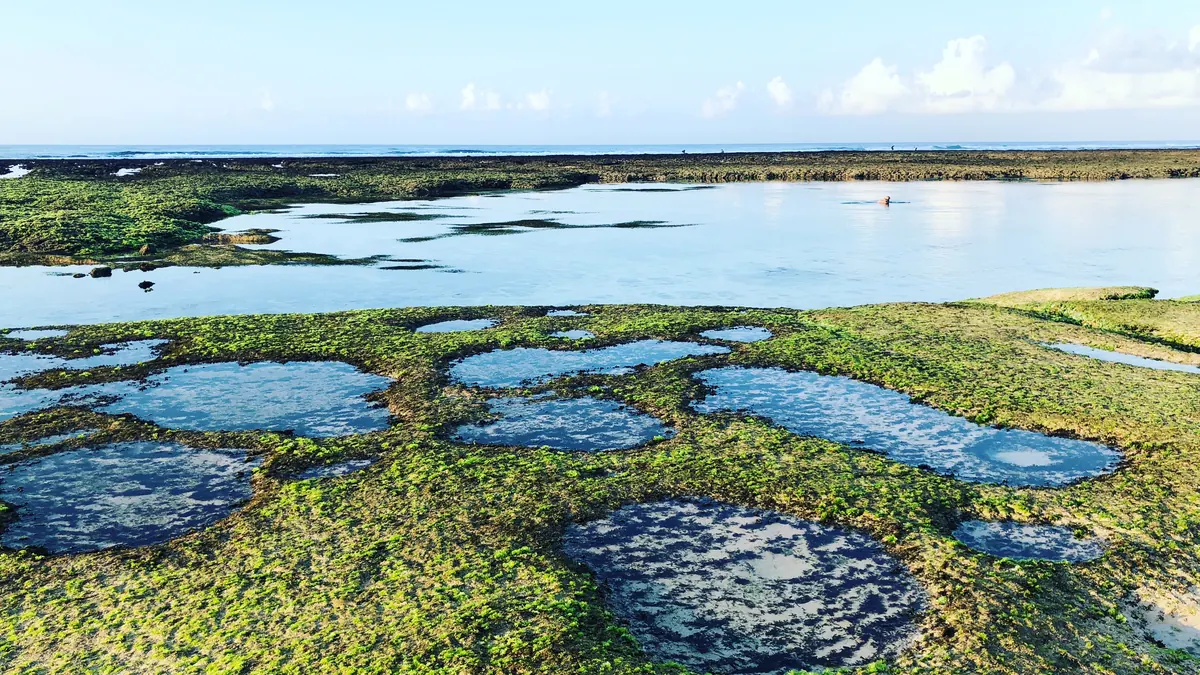
Go to the east side: Nusa Dua and Sanur. These face the other way, the current does not deliver the rubbish there, and in Nusa Dua's case it is a managed resort district that is cleaned daily. In January and February, when the west coast is at its worst, the Nusa Dua beaches are genuinely lovely. You may get seaweed, that is the local complaint, but seaweed is a different order of problem from plastic.
One thing to know before you book a wet-season beach holiday there: these are reef beaches. The water is shallow and the bottom is coral, not sand, and at low tide you are not swimming. Bring something on your feet. You can surf that side in the wet season and people do, but reef breaks are not where you learn.
The other wet-season move is to stop planning around beaches altogether. Ubud, the waterfalls, the temples and the inland north are all better in the rain than a beach is, and everything is green in a way it never is in August.
The worst time to visit Bali
January and February, and it is not close. Between them they bring 310mm and 285mm of rain across 26 and 27 wet days, humidity at 86 and 87%, the strongest monsoon weather of the year, and the west-facing beaches at their dirtiest. February is the one people underestimate: it is when the rain stops behaving like tropical showers and starts behaving like weather, with wind that gets close to storm strength and days that never brighten.
December is worse than its reputation suggests too, 268mm across 26 days, but it gets a pass because people come for Christmas and New Year anyway.
None of these months is unusable. They are simply the months where the island asks something of you, and where the difference between a good trip and a bad one is entirely in what you booked and where.
The best month to visit Bali
August, narrowly, if you can tolerate the crowd. It is the driest month by a wide margin, 58mm against July's 90mm and January's 310mm, the humidity is low for Bali, the nights are the coolest of the year at 22.6 degrees, and the beaches are clean.
July if you want the same weather with slightly better value, and it is the least humid month of all at 81%.
September if you want the dry season without August. The first half is still properly dry and the crowd thins noticeably once European holidays end. This is the month locals pick.
The only thing you give up in July and August is sea temperature: 28 degrees rather than the 30 you get in February. In practice that is the difference between warm and very warm, and nobody has ever cut a swim short over it.
Bali high season and low season
High season is July and August, plus the fortnight around Christmas and New Year. July alone took 697,000 foreign arrivals in 2025, about a fifth above an average month, and August adds the European holidays on top. Expect to book restaurants, expect traffic on the Bukit road at six, and expect the airport at its worst.
Bali low season is January to March, and again from late October into November. Prices drop, the roads clear, and you can walk into places that need three days' notice in August.
Shoulder, May, June, September, October, is the answer for most people. You get dry-season weather without high-season prices or crowds. September is the pick of them: the first half is still properly dry and the crowd thins the moment European schools go back.
When Bali is cheapest and least crowded
May, June and October. These are the shoulder months and they are the value answer: rainfall of 132mm, 115mm and 107mm is nothing like the wet season, the beaches are clean, and you are not competing with school holidays in three hemispheres.
October is the underrated one. It is drier than May, the sea is back up to 29 degrees, and the wet season has not arrived. The risk is that it arrives early: November goes from 107mm to 213mm, and the change can come in the last week of October rather than the first of November.
Bali at Christmas and New Year
Nobody should come to Bali for New Year, and everybody does, so there is no point in advising against it. December brings 268mm of rain over 26 days at 84% humidity, the west coast beaches are already dirty, and prices are at their annual peak. If you are lucky you get a bright week and fly home on the tenth having barely seen rain. If you are not, you get the version people come back and complain about.
So: come, but come knowing. Book somewhere with a good indoor room and a pool you do not mind swimming in while it rains, put the beach days on the east side, and treat any clear afternoon as a gift rather than the plan. The people who have a miserable Bali Christmas are almost always the ones who booked it expecting August.
Nyepi and the ogoh-ogoh: the one day the island closes, and it moves every year
Check the date before you book anything, because it is different every year. Bali does not run on our calendar. The island keeps two of its own, and the one that decides Nyepi is the Saka calendar, which is lunar: each month begins the day after a new moon, runs fifteen days up to the full moon, then fifteen back down to the dark. Nyepi is the day after Tilem Kesanga, the dark moon of the ninth month, so it always lands on the darkest night of that cycle and always somewhere in March. The exact date is set and announced by the Indonesian ministry of religious affairs, which is why no rule of thumb will help you.
The next one is Tuesday 9 March 2027, opening Saka year 1949, running six in the morning to six the next. Look it up for your own year rather than trusting any article, this one included.
It is not a soft observance. No going out, no lights, no noise, no work. Hotels keep guests inside, the pecalang patrol the streets, and Ngurah Rai airport closes for a full 24 hours: the only airport in the world that shuts annually for a religious observance. Nothing lands, nothing leaves. If your flight is on that date, it does not exist.
You will notice two things in the days before. The supermarkets get stripped: by the evening before, the shelves look like a storm is coming, because everyone is laying in a day's food. And a certain number of people book flights out, having discovered they would rather cross an ocean than spend twenty-four hours in a room with themselves. It is funnier every year.
If you are on the island for it, you got lucky, and you should stay. Nyepi night is the one night a whole island turns its lights off. There is no glow on the horizon, no headlights, no phone screens on a terrace across the valley. The sky that comes out is not the sky you know: the Milky Way sits there like something spilled, satellites cross it, and shooting stars arrive often enough that you stop pointing and just start wishing. People who have lived here for years still talk about their first one.
And the night before Nyepi is the opposite of quiet. This is Pengerupukan, and it is one of the best things on this island. Every banjar, every neighbourhood, spends weeks building an ogoh-ogoh: a giant demon out of bamboo, papier-mâché and paint, three or four metres tall, fangs and claws and rolling eyes. Much of the work is done by the kids and teenagers, it is openly competitive between neighbourhoods, and there are prizes. Then every village parades its monster through the streets on bamboo poles, dozens of shoulders under each one, gamelan behind, the whole banjar walking with it.
The story underneath is worth knowing, because it makes the silence make sense. The ogoh-ogoh are Bhuta Kala: the year's accumulated bad energies, given a body on purpose. The parade draws them out and carries them through the village, and then the effigies are burned, which is good winning over bad in the most literal staging anyone has come up with. The next day the island plays dead: no light, no sound, nothing moving, so that anything still wandering looks down, sees an empty place, and moves on. That is why you are asked to stay in. You are not being punished, you are helping the island pretend nobody lives here.
In practice not every ogoh-ogoh burns. Some banjar keep the best one, and you will see a demon standing at a crossroads for weeks afterwards, slowly going soft in the rain. Nobody minds. The point was the walk.

The best time to surf in Bali
The dry season, and specifically the west coast. The swell is measurably bigger from June to August, 2.1 to 2.2 metres against 1.6 to 1.8 in the wet season, and the trade wind blows offshore on the Bukit. That is why Uluwatu, Padang Padang, Bingin and Balangan all work at that time of year and why the whole surf world turns up.
In the wet season it flips: the wind goes onshore on the west and offshore on the east, so Nusa Dua, Sanur, Keramas and Serangan become the answer. Reef, again, and not beginner water.
If you are here in August, go and watch the Rip Curl Cup at Padang Padang. It is an invitation-only contest, twenty-four surfers, twelve Indonesian and twelve international, and the format is unusual: the waiting period runs the whole month, they sit on it until the swell is right, and then the entire event runs in a single day with competitors given 48 hours to get to Bali. In 2026 the call came on 20 August and two sixteen-year-olds won it. It is not Nazaré and nobody is claiming it is, but the wave at Padang is a proper barrel and watching it from the cliff with the whole beach out is worth reorganising a day for.
And the honest note for beginners: none of the famous Bukit breaks are where you learn. They are reef. Learning happens on sand, at Kuta or Jimbaran, and that is true in every month of the year.
Questions people ask about when to visit Bali
What is the best month to visit Bali?
August, if you can take the crowds: 58mm of rain against January's 310mm, the lowest humidity of the year alongside July, clean beaches and the biggest swell. July is nearly identical and marginally less busy. September is the local's answer: the first half is still dry and the European holiday crowd has gone home.
What is the rainy season in Bali?
Classically November to February, with January and February the heaviest at 310mm and 285mm across 26-27 wet days, and humidity at 86-87%. February is the month that catches people out: the rain arrives as weather rather than showers, with near-storm winds and days that stay grey. The edges have become less reliable in recent years, but the shape of the year still holds.
Is it worth going to Bali in the rainy season?
Yes, if you change coast and change plans. The east side, Nusa Dua and Sanur, does not get the rubbish the west-facing beaches get, and Nusa Dua is cleaned daily. Inland Bali, Ubud and the waterfalls, is better in the rain than any beach is. What does not work is booking a west-coast beach holiday in January and expecting August.
Why are Bali beaches dirty in January and February?
Because the rain flushes the rivers. Everything discarded upstream comes down and out into the ocean, and the wet-season current puts it on the west-facing beaches: Kuta, Seminyak, Canggu, Jimbaran. Crews clear it and the next big rain brings more. The east-facing beaches at Nusa Dua and Sanur are largely spared, which is why they are the wet-season answer. You may get seaweed there instead.
How hot is Bali, and does it change through the year?
Barely. The daily high sits between 27.4 and 29.8 degrees in every month of the year, and nights between 22.6 and 24.2. Temperature is not the variable in Bali: humidity is. It runs 81-83% in the dry season and 86-87% in the wet, and that gap is the difference between comfortable and unpleasant.
When is the sea warmest in Bali?
February and March, at about 30 degrees. It is coolest in July and August at around 28, which is the one thing the best months give up. In practice it is the difference between warm and very warm.
When is Nyepi, and how does it affect travel?
It changes every year, so check yours. Nyepi follows the lunar Saka calendar: it is the day after Tilem Kesanga, the dark moon of the ninth month, and always lands somewhere in March, with the date announced by the Indonesian ministry of religious affairs. The next is Tuesday 9 March 2027, opening Saka year 1949, running six in the morning to six the next. The whole island stops, no going out, no lights, no noise, and Ngurah Rai airport closes for a full 24 hours, the only airport in the world that shuts annually for a religious observance. The ogoh-ogoh parades the night before are worth planning around rather than avoiding.
When is the best time to surf in Bali?
June to August on the west coast, when the swell runs 2.1 to 2.2 metres and the trade wind blows offshore across the Bukit: Uluwatu, Padang Padang, Bingin, Balangan. In the wet season it reverses and the east coast works instead: Nusa Dua, Sanur, Keramas. Both sides are reef. Beginners learn on sand at Kuta or Jimbaran, in any month.
When is Bali cheapest?
May, June and October: the shoulder months. Rainfall is 132mm, 115mm and 107mm, nothing like the wet season, the beaches are clean, and there are no school holidays driving prices. October carries one risk: the wet season sometimes arrives in its last week rather than in November.
How busy is Bali in July and August?
Bali took just under seven million foreign arrivals in 2025 and July alone accounted for 697,000 of them, roughly a fifth above an average month. August adds the European holiday season on top. Australia is the largest source market by a distance. If crowds are the thing you mind most, take September or the shoulder months instead.
What calendar does Bali use?
Two, and neither is the one on your phone. Saka is lunar: months begin the day after a new moon and the year turns at Nyepi, in March. Pawukon is a 210-day cycle unconnected to the moon, and Galungan and Kuningan come off it. Between them they set temple anniversaries, ceremonies and processions all year, which is why a road can close for an afternoon with no notice you were ever going to see. It is worth checking what falls in your dates before assuming a quiet week.
What is the ogoh-ogoh parade?
The night before Nyepi, called Pengerupukan. Every neighbourhood builds a giant demon out of bamboo and papier-mâché, three or four metres tall, largely by its own teenagers, and parades it through the streets on poles with gamelan behind. The figures are Bhuta Kala, the year's bad energies given a body so they can be carried out and burned. It is competitive between villages and there are prizes. Not every effigy is burned afterwards: some stand at crossroads for weeks.
What is there to do in Bali on Nyepi?
Nothing, and that is the point: you stay where you are sleeping for 24 hours. Bring food, a book and something to drink, because shops shut and the shelves empty the evening before. The thing worth staying awake for is the sky: with an entire island's lights off there is no glow anywhere, and the stars are better than you will see almost anywhere on earth. Some people fly out to avoid it. They are missing the best night of the year.
When is rainy season in Bali, and when does it start and end?
It runs November to March, with the heart of it in January and February. November is the switch: rainfall doubles from October's 107mm to 213mm, and the change often arrives in the last week of October rather than on the first of November. It eases through March, which still carries 222mm, and April is the first month that reads as dry at 141mm. The edges have become less reliable than the old November-to-February rule, but the shape holds.
Bali weather in January: what should you expect?
The wettest month of the year: 310mm of rain across 27 wet days, humidity at 86%, highs around 29 degrees and a sea at 29.7. Expect rain that lasts rather than passes, and expect the west-facing beaches, Kuta, Seminyak, Canggu, Jimbaran, to be carrying rubbish flushed down the rivers. If January is your only window, book the east side.
Bali weather in August: what should you expect?
The driest month of the year by a wide margin: 58mm across 19 wet days, humidity 82%, highs of 27.8 and the coolest nights of the year at 22.6. The sea is at its coolest too, 27.9, which in practice means warm rather than very warm. The swell is up and the beaches are clean. It is also the busiest month, so nothing about it is a secret.
Bali weather in November: what should you expect?
The turn. Rainfall doubles from October to 213mm across 25 wet days and humidity climbs to 85%, while the sea warms back to 29.9. Early November can still feel like a late dry season and the second half rarely does. It is the month where booking a beach holiday is a gamble rather than a plan.
Bali in December: is it worth it?
Wet and expensive: 268mm across 26 days at 84% humidity, with prices at their annual peak over Christmas and New Year. The west coast beaches are already dirty. People come anyway and many have a fine time: the ones who do not are almost always the ones who booked December expecting August.
When is Bali monsoon season?
The northwest monsoon runs roughly November to March and is what makes the wet season wet. Its worst behaviour shows up in February: sustained wind close to storm strength and rain that sits over the island for whole days rather than passing through in an hour. The monthly averages hide it, because a handful of severe days and a month of afternoon showers can add up to similar totals.
Bali sea temperature: how much does it change?
Between 27.9 and 30.3 degrees, all year. Warmest in February and March at 30.3, coolest in July and August at about 28. There is no month where the sea is cold, and the seasonal difference is the difference between warm and very warm.
How many days in Bali do you actually need?
Ten to fourteen if you want more than one base. The island is small on a map and slow on the ground: Uluwatu to Ubud is under sixty kilometres and takes two hours in traffic, and nobody enjoys doing that as a day trip twice. A week works if you pick one region and stay in it. Under five days, pick the south and do not plan an Ubud leg.